How Organization Roles Change in the AI Era
AI changed how teams build software. But most conversations stop at the tools — which AI to use, how to prompt it, how much code it generates.
The bigger question is different. How should the organization itself be structured when AI handles execution?
AI compresses the execution layer. The value of “I can write code” drops. The value of “I know what to build and why” rises. If AI can generate 80% of a feature, the bottleneck is not typing — it is judgment.
Leadership Becomes Architecture
When AI takes over execution, the value of leadership shifts. The most important work becomes making the key decisions, defining the rules, and creating the constraints that others — and AI — operate within.
This is what “architect” means in this context. Not just designing structures — but deciding what gets built, how teams work, and what rules AI agents follow. Every leadership role is becoming an architect of constraints in their domain.
Three Domains, Three Architects
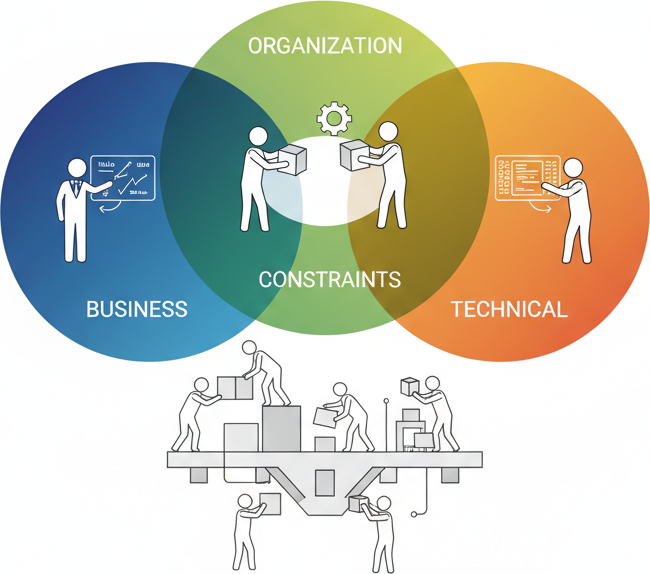
An organization needs constraints in three areas. Each one has a different owner.
| Role | Designs |
|---|---|
| PM | Product — strategy, rules, what to build |
| Manager | Operations — tools, teams, processes |
| Tech Architect | System — constraints, agents, guardrails |
PMs are business architects. They translate the company vision into detailed business rules that guide daily work. What do we build? Why? What does success look like? These decisions cannot come from AI. They require understanding the market, the customer, and the strategy.
Managers are organization architects. They design how the company works internally — communication norms, tools, team boundaries, what each team owns. Their job is not to supervise execution. It is to create the environment where people and AI can work well together.
Technical architects design the system. They define code conventions, build AI agents, set quality guardrails, and create the rules that make AI output consistent and trustable. When something goes wrong, architects improve the rules. They do not review every line — they design the system that catches problems.
The common thread: all three design constraints for others to operate within. Different domains, same function. None of them are doing the building. All of them are shaping how building happens.
Members — Broad Generalists with Judgment
Members build within all three sets of rules. Business rules tell them what to build. Organization rules tell them how to work. Technical rules tell them how the system operates.
AI handles the execution — writing code, generating tests, scaffolding features. What members need is broad knowledge and judgment. The engineer who can go from customer conversation to problem framing to architecture to shipping is much more valuable than someone who only does one slice.
This is a shift. Before AI, deep specialization was the most valued skill. A backend expert did not need to touch frontend. Nobody expected them to talk to customers. Now, specialists become architects. Members become generalists. Not because depth does not matter, but because AI fills the gaps in breadth. You do not need to be an expert in React if AI can scaffold 90% of it. Enough judgment to review the output is what matters. The deep expertise lives in the architects who design the rules.
Members work freely within a safe area. The architects defined the boundaries. The business rules defined the goals. The member’s job is to use judgment, solve problems, and deliver — with AI as the execution engine.
Smaller Teams, Broader Roles
If one engineer with AI can cover what used to take three specialists, teams shrink. Not because people were fired — but because fewer people carry more responsibility. Same output, fewer humans, each one operating more like a product-engineer hybrid.
The dedicated PM role shrinks. The function — business decisions, strategy, understanding the customer — does not disappear. It gets absorbed by engineers. In small teams, the person who builds also decides what to build. In larger organizations, a dedicated PM still makes sense. But even there, the wall between “person who decides” and “person who builds” gets thinner. Engineers are expected to have opinions about the business — not just take tickets.
Management changes too. A team of three does not need a full-time people manager. The role becomes more like a player-coach — someone who mostly builds but also coordinates. Less oversight, more contribution.
The risk is resistance. Some engineers want to stay in the “give me a well-defined ticket” mode. In teams optimizing for AI, that mindset becomes hard to justify. The engineers who thrive treat AI as a way to expand their scope — not just to write code faster.
The Junior Problem Is Real
Juniors are struggling in this new structure. Not because AI is hard to use — but because AI removed the execution work they used to learn through.
Before AI, juniors learned by writing code. They built intuition through repetition — debugging, refactoring, seeing patterns. Now AI handles most of that work. The skills juniors need earlier are the ones that used to come with experience: decision-making, judgment, problem evaluation.
Architects can help. Good guardrails create a safer space for juniors to operate. Clear rules, defined conventions, and automated quality checks let a junior produce work that meets the baseline. But judgment is still human. The guardrails reduce the risk — they do not replace the learning.
Training must change. Organizations cannot wait for juniors to accumulate years of experience before they make decisions. Decision-making and problem-solving must be taught earlier and more deliberately.
AI Helps You Think — But Does Not Decide for You
AI is more than an execution tool. It can research, propose ideas, surface options, and challenge assumptions. AI is a powerful thinking partner.
But there is a line. AI can present three approaches to a problem. It can analyze tradeoffs. It can find information faster than any human. The decision about which option fits your business, your team, your situation — that stays human.
This applies to every role. Architects use AI to explore constraints before defining them. Members use AI to evaluate options before choosing one. PMs use AI to research before setting strategy. In every case, AI expands what you can consider. The judgment about what to do is yours.
The human who approved the work carries the consequences. AI does not.
The Shift
AI did not change what organizations need. It changed where the value sits. Execution is cheap now. Judgment, constraints, and clarity about who decides what — that is the new bottleneck.
The organizations that get this right will move faster with fewer people. Not because AI replaced anyone — but because the structure made every person and every tool more effective.